
Ranked among Top Schools Of Uttarakhand
(Day & Residential)
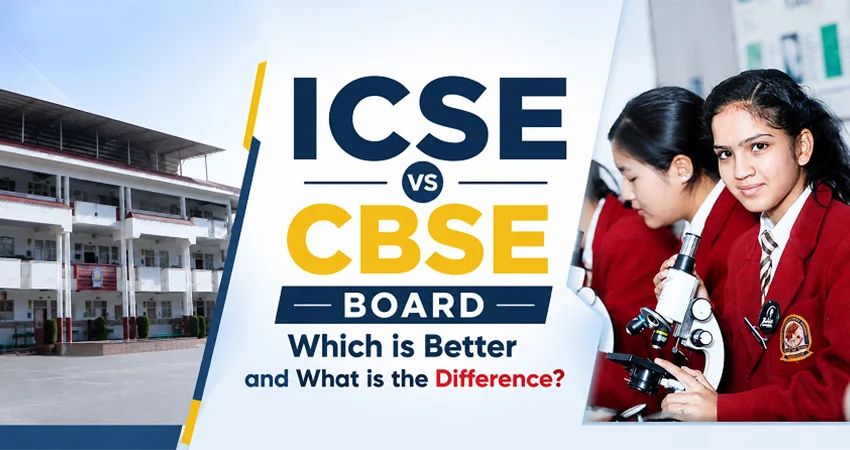
Two parents sit across a wooden office desk in Dehradun, flipping through sample textbooks under bright fluorescent lights. On the left lies a science manual thick with dense diagrams, detailed prose, and historical notes. On the right lies a streamlined booklet printed on glossy paper, organized into neat bullet points and quick summary tables. Both books cover the same physics principles. Yet, the way they structure information reveals a fundamental split in how Indian schools educate children.
That silent moment at the study table repeats itself in thousands of households each academic spring. Making that choice between the Indian Certificate of Secondary Education and the Central Board of Secondary Education is undoubtedly one of the most crucial decisions a family takes. When parents google “ICSE vs CBSE which is better,” they hope to find just one answer. However, it all depends far more on the child than the board.
Understanding the difference between ICSE and CBSE requires looking past brand reputation. It means watching how a child handles daily classroom assignments, evaluation methods, and long-term learning routines.
All debates regarding the ICSE vs CBSE education system revolve only around the size of textbooks.
However, the difference goes much beyond that.
CBSE helps the students get ready to scan through the important details and answer standardized questions within a short period of time. ICSE helps the students understand the context and answer in detail.
One prepares the student for speed-based multiple-choice questions, while the other prepares the student to think deeply.
Both systems work perfectly fine, but each caters to different minds.
A child whose parent works in the Indian Railways or the Defence Forces might study in Delhi one year and Chennai the next. CBSE was built for that exact reality. Operating directly under the Union Government, the board uses standardized textbooks from the National Council of Educational Research and Training. The chapters change very little from state to state, so changing schools mid-term feels less disruptive for a mobile family.
ICSE came from a very different tradition. Established in 1958, the council adapted its framework from the historic Cambridge School Certificate Examination. Instead of mandating a single government textbook, the board sets expansive syllabus guidelines and lets affiliated schools choose their own reading lists. The focus shifts from central standardization to deep reading and literary independence.
Understanding the differences between CBSE and ICSE is clearly reflected in their everyday homework and study process.
When comparing between ICSE syllabus and CBSE syllabus, the pace of classrooms makes the difference obvious.
Open a chapter of the CBSE science text book, and you will notice that the text gets to the point quickly. The emphasis is on understanding the core idea, its formula, and application to solve the question. This structure is in line with national level competitive exams such as JEE and NEET.
An ICSE chapter often spends time exploring the story behind an idea before asking students to calculate an answer. A Class 9 student studying history under ICSE does not simply memorize dates for a quick test. They read primary source documents, study world history in detail, and write extended essays. Science subjects split early into separate physics, chemistry, and biology tracks, each carrying its own lab journal.
Ask two students to explain Newton’s laws after class. A CBSE student may reach for the formula first. An ICSE student may begin with the example the teacher used that morning. One classroom asks students to recall the correct answer quickly. The other asks them to explain how they arrived at it.
Open an ICSE English paper, and you’ll find Shakespearean plays, poetry analysis, and detailed essays. Starting in middle school, students learn to dissect character motives and sentence structure. Mark schemes penalize grammatical errors, poor syntax, and weak vocabulary across every subject, including physics and history.
CBSE papers lay stress on communicative aspects. It lays emphasis on functional skills in language, such as the ability to write formal letters, write reports and summarize texts. The aim is evident, practical proficiency without wasting time on literary criticism.
CBSE assessment is based on the precision and speed of the answers. The papers consist of a high weightage of single mark questions, assertions-reasons and numerical applications. A regular three hour science paper comprises processing thirty-nine individual questions.
On the other hand, ICSE assessment depends on the depth of the explanations provided by the candidates. The papers involve subdivided questions which require the candidate to state the law, its underlying principle and make labeled diagrams. In addition to that, the internal evaluation has 50% of marks in some subjects like Computer Applications and Commercial Studies and is assessed on the basis of practical work and project work.
If your child’s immediate goal is JEE or NEET, the balance tilts towards CBSE.
The National Testing Agency designs major entrance examinations, including JEE Main, JEE Advanced, NEET, and CUET, directly from NCERT textbooks. A student attending a CBSE school reviews the exact diagrams, definitions, and problem types required for these competitive tests during regular morning classes.
The science doesn’t change. Gravity is still gravity. What changes is how students are asked to work with it. ICSE students cover the same scientific principles, often in broader detail, but the testing format requires an adjustment. They must shift from writing extended descriptive answers to solving rapid, objective questions while managing a heavier daily reading load.
For families planning higher education in the United Kingdom, the United States, Canada, or Europe, ICSE provides distinct preparation.
International admission counselors seek evidence of writing skills that span more than a few pages, research capabilities, and good proficiency in the English language. The research portfolios that are mandatory in ICSE classrooms match the expectations in international universities. Certain foreign universities might exempt candidates from taking English proficiency exams such as the IELTS and TOEFL based on the candidate’s ICSE English criteria.
CBSE qualifications are also recognized globally, but students often spend extra time outside class building the analytical essays, writing samples, and research profiles that top foreign universities ask for.
The comparison in terms of difficulty becomes evident when one looks at examination statistics and the inherent academic requirements involved in both. In national Class 10 board examinations, while ICSE is able to keep its overall pass rate at almost 99.1%, CBSE manages only a 93.6% pass rate for a much larger population comprising nearly 23 lakh students. However, the disparity in the pass rates has more to do with the structure of assessments and not difficulty levels. While ICSE evaluates volume and analysis of prose in up to ten subject papers with balanced daily load and internal project weightage of up to 20%-50%, CBSE focuses on five main subjects in which about 60% of the question paper evaluates numerical skills, objective knowledge and case studies based on competitive entrance examinations such as JEE and NEET.
| Metric | Central Board (CBSE) | Council Board (ICSE) |
| National Pass Rate (Class 10) | ~93.6% | ~99.4% |
| National Pass Rate (Class 12) | ~88.0% | ~98.2% |
| Class 10 Board Papers | 5 Core Papers | Up to 10 Separate Subject Papers |
| Primary Testing Mode | ~60% Objective & Application | ~70% Long-form Descriptive & Proofs |
| Internal Assessment Share | 20% Standard | 20% to 50% depending on subject |
Setting up an ICSE campus requires substantial physical investments. Because the board requires separate science laboratories, extensive library collections, and detailed practical testing spaces across multiple subjects, affiliated schools often operate with higher fee structures.
CBSE schools exist across a much wider economic range. From government-run Kendriya Vidyalayas to private institutions, the standardized curriculum allows quality schooling to run efficiently in almost any city or town.
Also Read: Leading CBSE Boarding Schools in India
Choosing between CBSE vs ICSE syllabus does not involve jumping on bandwagons and trends. It involves choosing a school setting that will be a fit with your child’s nature.
CBSE is the right choice if:
Choose ICSE if
This is where schools begin to matter more than boards.
A curriculum alone doesn’t teach a child. Teachers do. The syllabus printed in a handbook provides a framework, but daily classroom culture determines whether a child actually stays curious. In Dehradun, a town known for its deep educational roots, schools demonstrate how teaching methods transform standard board guidelines.
Doon International School in Dehradun is a living example that explains how this balance is attained. Doon International School in Dehradun does not use the CBSE system as an aid for rote learning of textbook material but, instead, utilizes it to create good problem-solving skills.
At Doon International School in Dehradun, lessons move naturally between theory and application. Science laboratories, evening study blocks, and mentor support give boarders and day scholars the structure they need to digest complex ideas without feeling burned out. Whether a student aims for national competitive exams or international university admissions, Doon International School in Dehradun grounds academic expectations in sports, creative projects, and personal care.
The selection of CBSE or ICSE entirely depends upon academic compatibility in the long run.
For excelling in the national-level competitive examination such as JEE or NEET, CBSE can be considered as an efficient choice due to its simplified course and fast pace. For developing good writing skills, English proficiency, and a wide knowledge base for studies abroad, ICSE is considered better.
In the end, the right CBSE vs ICSE decision entirely depends upon the capability of your child for daily study load and assessments.
What is the difference between CBSE and ICSE in daily study hours?
The primary difference lies in syllabus breadth and reading volume. CBSE focuses heavily on mathematics, science, and concise entrance exam preparation using standardized NCERT textbooks. ICSE emphasizes English language mastery, detailed humanities, and comprehensive subject analysis with significant weightage on internal project work.
Which board is better for JEE and NEET preparation?
CBSE offers a direct advantage for national competitive exams like JEE and NEET. The National Testing Agency designs these tests directly around the NCERT syllabus, allowing CBSE students to prepare for entrance exams during their regular school routine.
Can a student switch from ICSE to CBSE after Class 10?
Yes, students frequently transition from ICSE to CBSE for Class 11 and 12. Families often choose ICSE during early schooling to build language fluency and reading habits, then move to CBSE to focus on national competitive entrance exams.
Is ICSE recognized by international universities?
Yes, ICSE is widely recognized by universities in the UK, US, Canada, Australia, and Europe. Admissions boards value the strong English language grounding, descriptive writing skills, and research habits that the council requires.
Where can I understand the CBSE and ICSE difference in Hindi?
Many national education portals and official board sites provide summary downloads in Hindi. However, parents comparing academic streams can consult bilingual academic counselors at major institutions like Doon International School in Dehradun to understand subject choices and exam requirements in both Hindi and English.